
Food Web
Complex connections between predators and prey form a healthy, balanced food web. A balanced food web supports a productive ecosystem.
A food web is a complex network of connections between plants, animals and other organisms that eat—and are eaten by—each other. Food webs show how energy flows through an ecosystem. Unlike a food chain, which follows a single path from prey to predator, a food web includes interconnected and overlapping relationships. The Chesapeake Bay food web includes plankton, filter feeders, fish, birds, mammals and even people.
What powers the Chesapeake Bay food web?
The Chesapeake Bay food web is powered by sunlight and nutrients, which support underwater grasses and free-floating phytoplankton, or tiny, plant-like organisms that produce energy through photosynthesis. The energy produced by plants and phytoplankton is passed on to microscopic zooplankton, bottom-dwelling invertebrates and forage fish; their energy is passed on to top predators. Each of these organisms depends on each other in this complex and dynamic system.
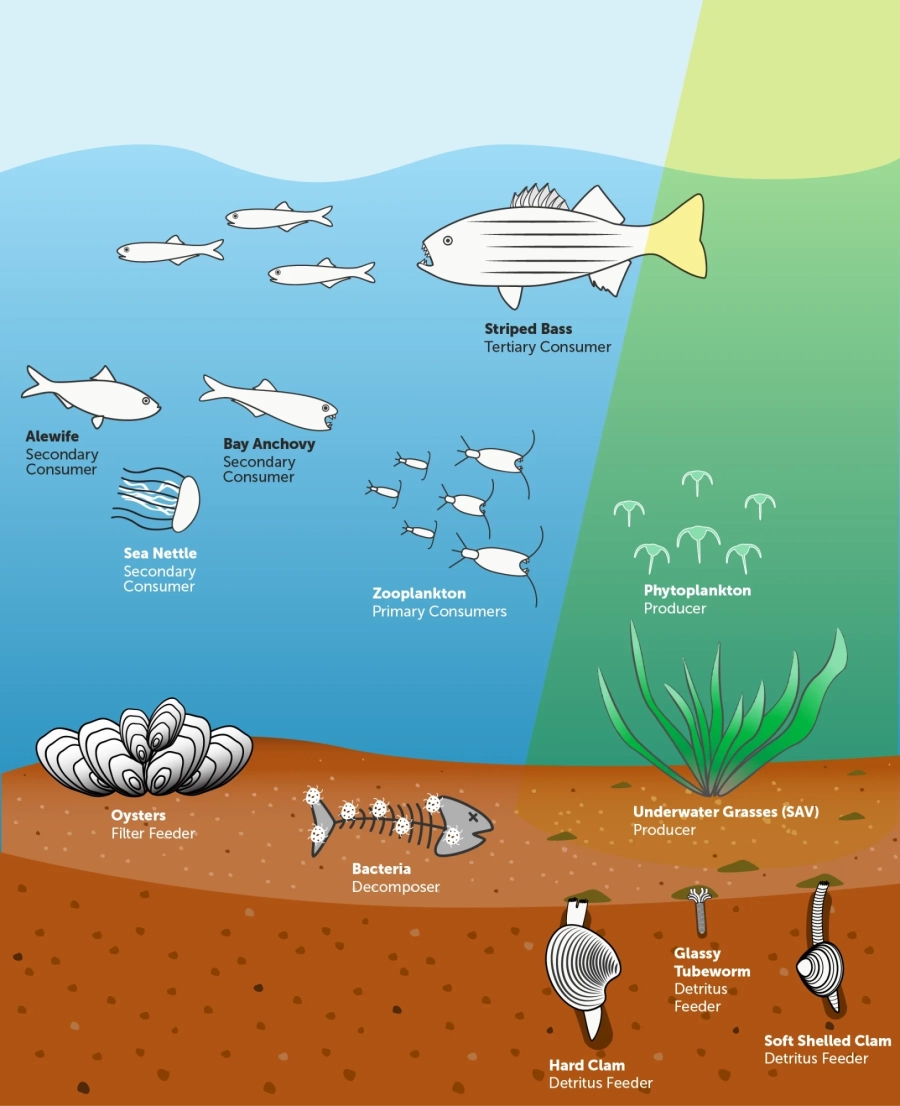
Show image description
The infographic shows a cross-section of an underwater habitat, from above the water's surface to below its muddy bottom. The infographic features drawings of different plants and animals, with text labels that indicate the role the plant or animal plays within this habitat's food web. In an underwater area where sunlight is shining, phytoplankton (floating in the water) and underwater grasses (growing out of the sediment) are labeled as producers. Swimming elsewhere, zooplankton are labeled as primary consumers; an alewife, bay anchovy, and sea nettle are labeled as secondary consumers; and a striped bass is labeled as a tertiary consumer. On the habitat's bottom, oysters are labeled as filter feeders and bacteria are labeled as decomposers. Buried in the mud, a hard clam, soft shell clam and glassy tubeworm are labeled as detritus feeders.
What role do different organisms play in the Chesapeake Bay food web?
Each of the organisms in the Chesapeake Bay food web occupies a unique position in the flow of energy through the ecosystem. These trophic levels, or positions in the food web, are determined by what an organism eats.
Producers
Producers use photosynthesis to convert sunlight and nutrients into energy. Producers form the base of the food web, and include underwater grasses and plant-like phytoplankton. When too many nutrients enter the water, the phytoplankton population can grow too large, forming algae blooms that lead to low-oxygen dead zones. Healthy phytoplankton populations—with enough light and nutrients to support normal growth—are a good indicator of water quality.
Primary and secondary consumers
Primary consumers feed on producers. This group includes free-floating animals called zooplankton and bottom-dwelling invertebrates such as mussels, clams and oysters.
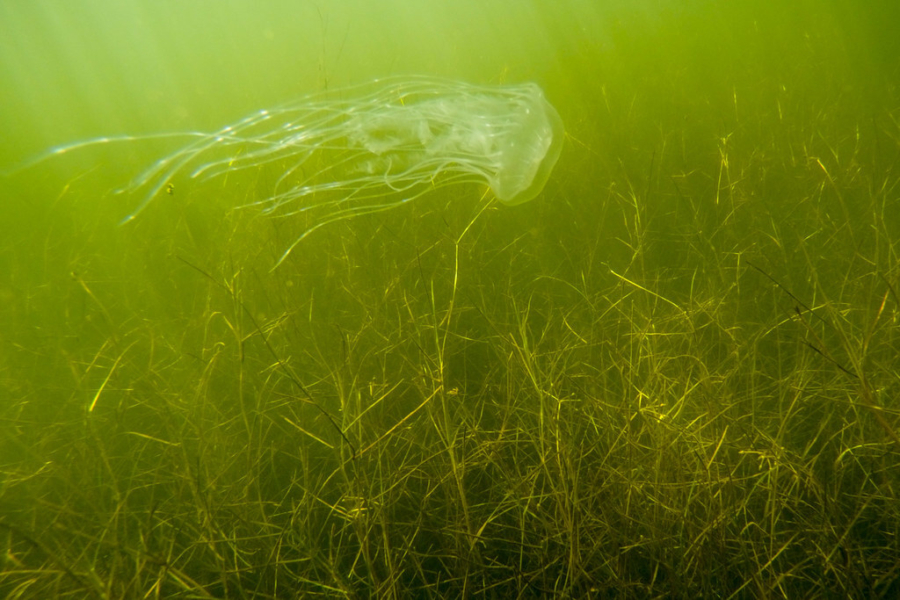
Secondary consumers feed on primary consumers. This group includes larger zooplankton, such as copepods, small crustaceans and sea nettles, and forage fish, such as menhaden, bay anchovy and juvenile weakfish and spot.
Benthic or bottom-dwelling communities often contain primary and secondary consumers. These communities include epifauna, which live on or attached to rocks, shells, pilings or the bottom of the Bay, and infauna, which burrow into soft bottom sediment. Epifauna include oysters, barnacles, sponges, sea squirts, sea stars, mussels and some small fish. Infauna include worms, clams, snails and some small crustaceans. Because most benthic creatures can’t move very far, if at all, they can’t avoid low-oxygen dead zones, clouds of suspended sediment or chemical contaminants. Healthy benthic communities are a good indicator of a healthy ecosystem.
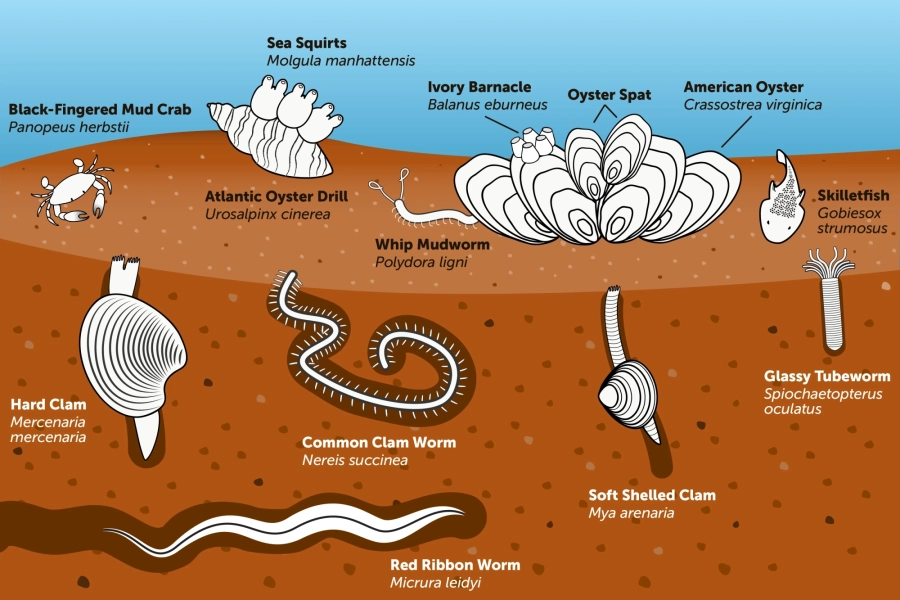
Show image description
The infographic shows a cross-section of a benthic habitat, which includes the area on and below a waterway's bottom sediment. The infographic features drawings of different organisms that can be found in a typical benthic community in the Chesapeake Bay, with text labels that provide each organism's common and scientific names. Some organisms live on top of the sediment; some are attached to other organisms' shells; and some are burrowed into the mud. On top of the sediment, the infographic shows a black-fingered mud crab (Panopeus herbstii), whip mudworm (Polydora ligni), skilletfish (Gobiesox strumosus), Atlantic oyster drill (Urosalpinx cinerea), and clump of American oysters (Crassostrea virginica). Three sea squirts (Molgula manhattensis) are attached to the oyster drill, and both oyster spat and ivory barnacles (Balanus eburneus) are attached to the oysters. Below the sediment, the infographic shows a hard clam (Mercenaria mercenaria), soft-shelled clam (Mya arenaria), common clam worm (Nereis succinea), glassy tubeworm (Spiochaetopterus oculatus), and red ribbon worm (Micrura leidyi).
Tertiary consumers
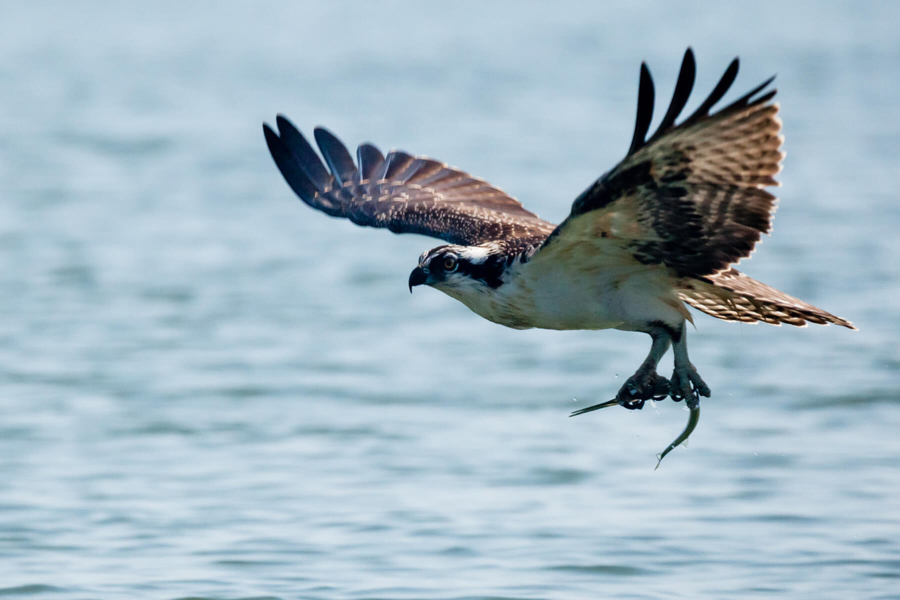
Tertiary consumers are top predators. This group includes fish like striped bass, bluefish and weakfish, birds, mammals and people. Tertiary consumers rely on energy passed up through invertebrates and smaller fish, which means the stability of lower trophic levels is essential for their survival.
Decomposers
Decomposers feed on dead plants and animals, breaking down organic matter into nutrients that once again become available for plants and other producers. Decomposers include bacteria, worms, clams, snails, mussels and crustaceans.
How do human activities affect the Chesapeake Bay food web?
Humans can disrupt the Chesapeake Bay food web by polluting the environment and consuming too many fish and shellfish.
- Nutrient pollution can fuel the growth of algae blooms that lead to low-oxygen dead zones harmful to fish and underwater life.
- Sediment pollution can block sunlight from reaching underwater grasses and smother benthic organisms.
- Chemical contaminants can accumulate in animal tissue, affecting the survival, growth and reproduction of fish and wildlife.
- Overharvesting fish and shellfish has the potential to remove too many valuable species from the Bay, impacting predator-prey relationships and disrupting the balance of the food web.