
Five types of underwater grasses found in the Chesapeake Bay
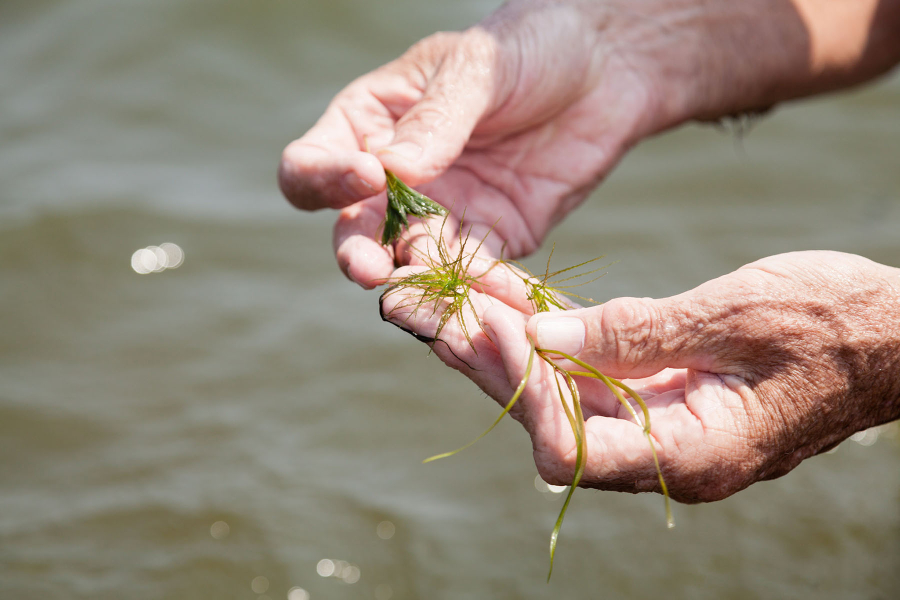
The plants that grow in the shallow waters of the Chesapeake Bay and its rivers, streams and creeks are a critical part of the Chesapeake Bay ecosystem. Known as underwater grasses or submerged aquatic vegetation (SAV), these plants improve water quality by reducing erosion, trapping loose sediment and absorbing nutrient pollution. During photosynthesis, underwater grasses add dissolved oxygen to the water which aquatic critters need to survive. They also serve as habitat for vulnerable young fish and crabs and provide food for migrating waterfowl.
Below, learn about five types of underwater grasses that are found in the Chesapeake Bay.
1. Eelgrass
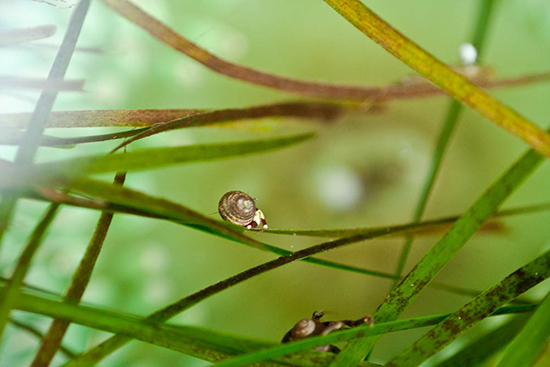
Eelgrass prefers the saltier waters of the middle and lower Chesapeake Bay, making it one of the dominant species in the Virginia portion of the Bay. This underwater grass has long, ribbon-like leaves that can grow up to four feet long, but vary in size depending on the plant’s location.
Eelgrass provides important habitat for blue crabs. Juveniles and molting adults forage for food and hide from predators among eelgrass beds. But warming water temperatures from changes in climate may threaten future eelgrass abundance, because this sensitive plant becomes distressed when waters are warmer than 86 degrees Fahrenheit for long periods of time.
2. Widgeon Grass
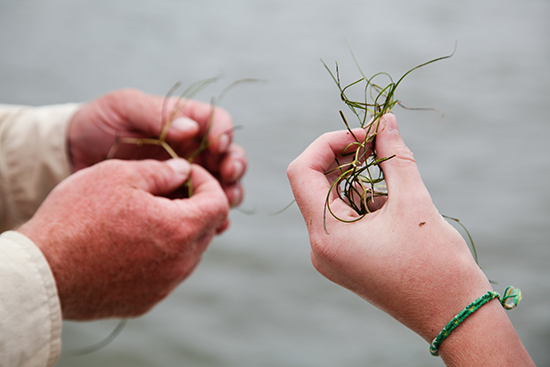
The delicate, thread-like widgeon grass prefers saltier waters, ranging from the slightly brackish upper Bay through to the saltier lower portion. Like eelgrass, it is one of the dominant underwater grass species found in the Virginia portion of the Bay. Widgeon grass is also known as ditch grass, because it sometimes grows on land in the ditches alongside roads and farm fields.
In recent years, a strong increase in the amount of widgeon grass has helped the Bay reach record acreages of underwater grass beds. However, because widgeon grass is a “boom and bust” species—its abundance can rise and fall from year to year.
Because of how much widgeon grass grows in the Bay and its rapid growth and decline, this grass is thought to be largely responsible for the substaintial changes in the Chesapeake Bay’s overall underwater grass abundance. The grass will die when water quality is poor but will come back as water quality gets better.
3. Water Stargrass
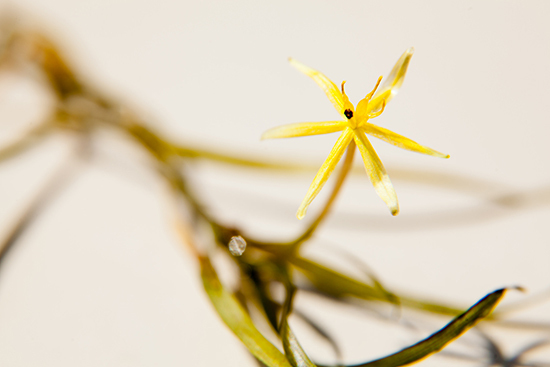
Perhaps one of the prettiest underwater grasses, water stargrass is named for the distinctive yellow, star-like flowers that bloom along its freely-branching stems. It grows in the fresh waters of the upper Bay and in tributaries throughout the region.
If water stargrass washes ashore, it can sometimes grow on land. The land form also flowers, but its leaves are small and leathery. This form of water stargrass is sometimes called the mud plantain.
4. Hydrilla
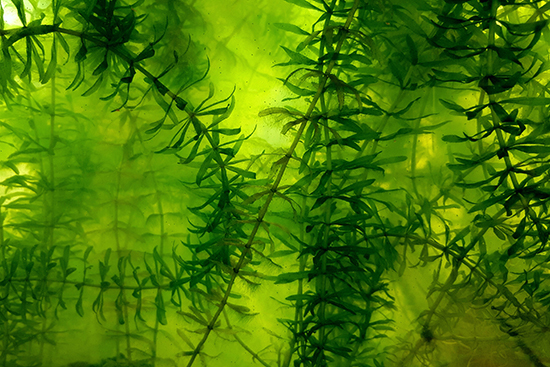
Non-native hydrilla grows in freshwater portions of the Bay and its tributaries, although it has also been found in some saltier waters. Its long, branching stems are covered in tiny leaves with teeth along the edges. Because hydrilla does not need as much light as other underwater grasses, it can be found in murky waters with more sediment pollution.
Introduced to the United States in the 1960s through the aquarium trade, hydrilla was first detected in the Chesapeake Bay region in 1982 in the Potomac River near Washington, D.C. Within 10 years, hydrilla had grown to cover 3,000 acres of the river.
5. Wild Celery
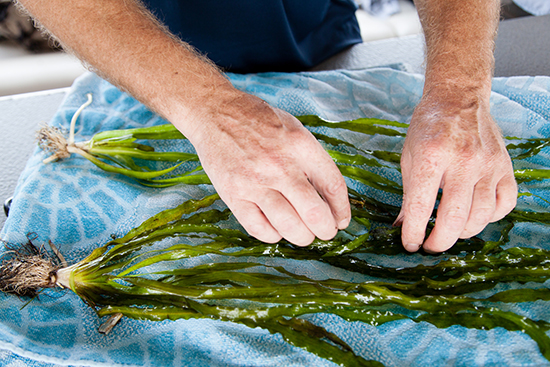
Similar in appearance to eelgrass, the long, ribbon-like leaves of wild celery can be distinguished by the light green stripe running down the center of each leaf. Wild celery grows in fresh and slightly salty waters throughout the region, including the upper Chesapeake Bay and its tidal and non-tidal tributaries.
Wild celery can withstand disturbance from waves and is more tolerant of murky, pollutant-rich waters than other underwater grasses. Many underwater grasses serve as an important food source for critters, but wild celery’s buds and roots are particularly important to waterfowl as they migrate and overwinter in the Bay region.
In fact, the scientific name for the canvasback, Aythya valisineria, comes from the first part of wild celery’s scientific name, Vallisneria americana.
Restoring underwater grasses
Underwater grasses are sensitive to pollution: as excess nutrients and sediment flow into the Bay, low-oxygen dead zones and cloudy waters deprive the plants of the oxygen and sunlight they need to survive. In the 1950s and 60s, declining water quality caused many underwater grass beds—which once grew so thick that boats were unable to move through them—to disappear.
Today, Chesapeake Bay Program partners are working to restore underwater grasses across the estuary. Track our progress toward our 185,000-acre goal.
Comments
Dundee Creek in the 90s was one of the most beautiful grass areas in the bay. Water was gin clear teaming with Life tons of bass bluegill and yellow perch in the late 90s early 2000s the DNR sprayed and killed all the grass.. never recovered now it’s just a mud bowl lifeless.
Is there any plan by the Department of natural resources to replant grass and the Dundee Creek the previous grass that was phenomenal was bushy with openings look like Hydrilla possibly.
Robert, you should only introduce plants that are native to the region. We recommend research these 5 grasses to see if they are native to NV.
Hi can these fresh water plants be introduced to other rivers & lakes? I work at State Parks NV.
Are there grasses that china could grow, and harvest after the flood is gone?
I LIVE ON WATER FRONT PROPERTY IN BEAR CR.COUEK OFF THE PATAPSCO.L
.LIVED HERE ALL MY LIFE I HAVE NEVER SEEN THIS GRASS INTHE WATER BEFORE,ITS THICK AND PROBLY WINT LAUNCH JET SKI AND BOAT THIS YEAR DUE TO THE GRASSES THICKNESS. HOWEVER I CANT IDENTIFIY THE GRASS. I INVITE ANYONE TO MY HOME TO EVALUATE. MY ADRESS IS IN DUNDALK.PLEASE HELP. THANK YOU FOR ANY HISTORY OR INFO.THANK YOU.
RIVER
Hi Alan, thanks for the comment! Given the time of year, it's likely that the grass you saw has turned a red/brown color because it has lost all of its chlorophyll and is dying back for the season, or that it is already dead. There are species of SAV that appear red. Here in the Bay, we have a species of naiad that's got quite a lot of red in it, but not this time of year. There's also the rare occurrence that a patch of marsh plants finds itself submerged, and they often have some red pigmentation.
I have noticed a few clumps of red colored SAV in about 4 ft MLW in Milford Haven in Mathews County.
I would like to know if red colored SAV is common.
Hi Vic, at this point, any use of herbicides is thoroughly regulated. All SAV in the Bay is considered good SAV. Feel free to look through our SAV Fact Sheet for more information! https://gis.chesapeakebay.net/sav/
Was there any herbicide (24-D) intentionally put into the Chesapeake Bay and it tributaries to kill bay grasses?
This seemed to have happen in the late 60’s and early 70’s with massive fish kills and the lost of grasses.
The grasses would try to make a comeback yearly but died off as the roots would grow and reach the herbicide level that rests on the waters floor and die.
The reason for this was complaints filled by recreational boaters and it’s industry, commercial watermen, waterfront property owners ect.
The boaters couldn’t maneuver their boats in the grasses to reach deeper waters where the grasses couldn’t grow because of lack of sunlight.
I’ve lived on the lower Potomac River my entire life and have seen many changes from swimming in waters as clear as the Caribbean in the 60’s to the decline of water quality , lost of fish species, sturgeon, garfish, crabs including horseshoe just to name a few
This year (2020) seems to be a remarkable growth
In grasses. Hope this continues, but people are complaining about it again. They have no idea of the importance of these grasses. Most have never seen them and complaining that waters don’t look as nice.
Hope to get some sort of an answer.
Thank you for your time,
Vic Foote
5/16/2020
Charles County Md
Hi Jim, “Boom and bust” means that the abundance can fall from year-to-year as the grasses can rapidly reproduce (they can self-reproduce), but are highly susceptible to changes in pollution in the water or extreme weather events. One hurricane could knock out all of the grasses for one given year. And yes, it is common to see no grasses and then a boom. It’s an indicator that your water is healthy! Here’s some more information you may find interesting:
Widgeon grass in Eastern Bay: https://gis.chesapeakebay.net/images/SAV/EasternBay(EASMH)_TT_11.5.19.pdf
Widgeon grass in the Lower Choptank River: https://gis.chesapeakebay.net/images/SAV/LowerChoptankRiver(CHOMH1,CHOMH2)_TT_11.5.19.pdf
Widgeon grass details:
https://www.chesapeakebay.net/discover/field-guide/entry/widgeon_grass
My wife and I have owned a house on the eastern branch of Dixon Creek near Easton for about five years. We never saw any underwater grasses but this spring, we are seeing an explosion of grasses. It looks like it might be widgeon grass. The article mentioned the boom and bust cycle but why is that? And is it common to see no grasses for years and then such a wide spread? Thank you.
Thank you!
Your comment has been received. Before it can be published, the comment will be reviewed by our team to ensure it adheres with our rules of engagement.
Back to recent stories