
Seeing green in infrastructure
Green infrastructure can help local governments lower costs and improve communities, according to the Environmental Finance Center
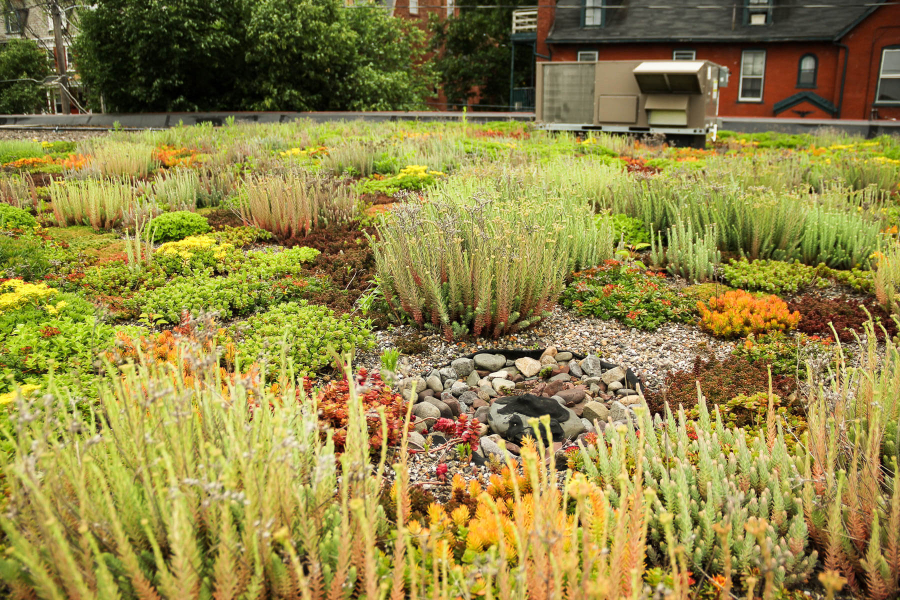
Infrastructure is a quiet backbone of our society, but the debate between traditional gray or new green stormwater techniques is anything but. Gray infrastructure refers to the manmade, and in many places aging, hard structures that collect water before releasing it into rivers and streams. This includes things like pipes, reservoirs and treatment plants. Green infrastructure, a relative newcomer to the scene, uses soil and vegetation to help slow the flow of runoff and manage rainwater where it falls. A new report by the University of Maryland Environmental Finance Center finds that by combining green and gray infrastructure systems, local governments can lower costs, solve systemic water woes and improve the lives and aesthetic of their communities.
An intro to stormwater infrastructure
Unless you live in a rural area, you are likely connected in some way to a sewer system. Underground pipes, downspouts, streets , culverts, catch basins, storm drains, gutters and ditches all help transport stormwater from where it lands as rainfall into a body of water.
Our smooth, hard-walled systems transport water exceptionally well. In a storm, a trickle of water in the gutter can quickly become a flood as it is funneled from gutters to storm drains to pipes. Everything that it touches—motor oil, cigarette butts, diapers, half eaten rolls, plastic trash, dog feces left in the grass, gasoline, vomit and urine—all travel along with the stormwater and directly into waterways.
Many older cities have what is called a combined sewer overflow (CSO). Instead of heading directly into a waterway, stormwater is collected in the same pipes as sewage and both are transported to a sewage treatment plant to be processed. Over time, cities have grown and those old sewage pipes now have to handle a much greater volume. Paved surfaces spread out in all directions and channel water into a torrent, which joins the already overtaxed sewage pipes. During a heavy rainfall in a CSO city, the pipes can overflow. Untreated human and industrial waste pours directly into local rivers and streams along with the stormwater.
As older systems have begun to fail or reach their capacity, local governments have been searching for new strategies to help their towns and people. Green infrastructure—using elements like trees, green roofs and rain gardens—is an adaptable approach that can be used in communities of all sizes. Instead of being treated in one central location, as in gray infrastructure, water in a green system is captured and treated right where it falls.

Benefits span the spectrum
Green infrastructure can help to defer or avoid certain planned costs all together. Gray infrastructure must be expanded, replaced, repaired and constantly upgraded in order to remain effective. By phasing in green measures, maintenance costs for green infrastructure are refocused on chemical water treatment or the electricity to run facilities. Flood damage is significantly reduced where green infrastructure is in use as water volume is dissipated over a large area.
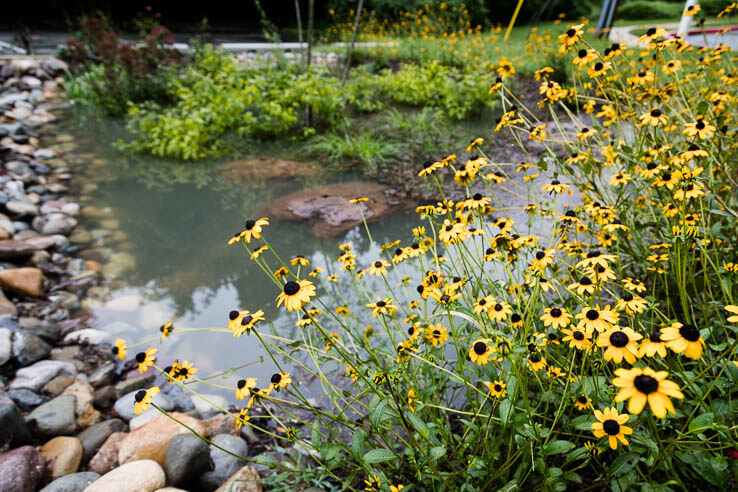
Above the ground, green roofs bring plants closer to the clouds and slow rain before it ever reaches the ground. In addition, green roofs act as insulation for a building and significantly reduce its energy demands. With greenery and flowers where once was plain roofing, a property’s aesthetic value goes up as its energy costs go down. Green infrastructure can even be a natural area that already exists, like a waterway or empty lot. By restoring a stream or putting in a swath of trees, called a riparian buffer, along the water, that area becomes a draw for the community to find stress relief in nature. With the increase in vegetation, air pollution levels drop. Green infrastructure increases aesthetic appeal, helps mitigate flood risk, provides habitat, and addresses stormwater. Tangible or intangible, communities benefit from a holistic stormwater approach.
Barriers to green infrastructure
Gray infrastructure has so long been the standard that many stormwater managers are simply not familiar with green infrastructure and all it has to offer. When they are, the hurdles can be intimidating.
The way stormwater management functions now, only the movement of stormwater is assessed. Stormwater managers are left without resources to tally the economic benefits of various stormwater measures. Regulatory requirements often make holistic benefit analysis unworkable at the local level. Local stormwater managers are singularly focused on meeting stormwater compliance levels to the exclusion of every other consideration, like benefits for the community of a more holistic nature.
Many current stormwater tools also overlook operating and maintenance costs. Green alternatives are considered more expensive because avoided costs aren’t taken into account. Stormwater managers are largely prevented from incorporating other benefits—like economic savings, local idiosyncrasies, and aesthetic and community value improvements—into their financial decision making.
An integrated environment
In both the way stormwater remediation policy is written and implemented, a larger view must be taken into consideration in order to benefit both people and then environment. Implemented on their own, elements of green infrastructure can be strenuous to undertake. Instead, capitalize on current municipality plans by incorporating green elements into a scheduled upgrade. Addressing economic, stormwater and environmental concerns all benefit the full community and must be considered.
The natural elements of the Chesapeake Bay region are tightly woven with the human. Trying to separate them or pit them against each other benefits neither nature nor humans, and is true for implementation of infrastructure as well. The decision for local governments is not whether to take a gray or green approach, but rather how to best integrate them together for the good of their communities.
Comments
We all know that water runs downhill. The larger area that is covered in solid, non-permeatable surfaces (think roofs, roads and parking lots) the more water that is impacting the downhill communities. I would suggest that communities work together. Legal and budget concerns tend to make each community a solo entity in planning and implementing flood control.
We could use more green infrastructure programs in prisons. Inmates could earn a certificate in green infrastructure design that would allow them to play an integral role in ecologically sustainable development while obtaining fulfilling and steady employment after leaving prison.
Thank you for this great summary of the benefits of (and barriers to) green infrastructure. The American Society of Civil Engineers points toward a $105B gap between committed public funds and those needed to maintain and update our water infrastructure through 2025. World Resources Institute and The Nature Conservancy recently published a report called "The Business of Planting Trees" (https://www.wri.org/sites/default/files/business-planting-trees_0.pdf) that highlights one promising solution: impact investors (see Fresh Coast Capital profile on page 38-39). Communities have so much to gain from green infrastructure and we hope private capital can help cities realize these benefits sooner.
Very good article that I think does a nice job of explaining both green and gray as well as acknowledging that ultimately we will need to combine both strategies in our urban areas where constraints are plentiful. To succeed, I think its key that we implement policy that gives practitioners maximum flexibility to meet water quality goals with a diverse list of proven solutions and also puts the drivers in place to ensure all of our stormwater BMPs are maintained as required. Whether green or gray we continue to fall short in keeping our solutions operational! Putting a spotlight on lifecycle cost vs simply the initial capital and installed cost will be a critical step in this process.
Great article Caitlyn. Proper storm water management can save local governments money by avoiding damage to sewer lines, roads, and bridges, as well as reducing property damage, the need for dredging and lost business revevues.
Thank you!
Your comment has been received. Before it can be published, the comment will be reviewed by our team to ensure it adheres with our rules of engagement.
Back to recent stories